What Is a Tapered-Bore Stripper Sleeve?
A tapered-bore stripper sleeve — known in Chinese as 锥孔推板套 — is a precision cylindrical bushing installed in the stripper plate of an injection mold. Its defining feature is a slightly conical inner bore (typically 1°–3° included taper angle) that mates with a matching tapered land on the ejector pin or ejector rod. This tapered interface serves two critical functions simultaneously: it self-centers the ejector pin during every ejection stroke, and it provides a large bearing surface that distributes ejection load evenly across the sleeve wall rather than concentrating it at a sharp edge.
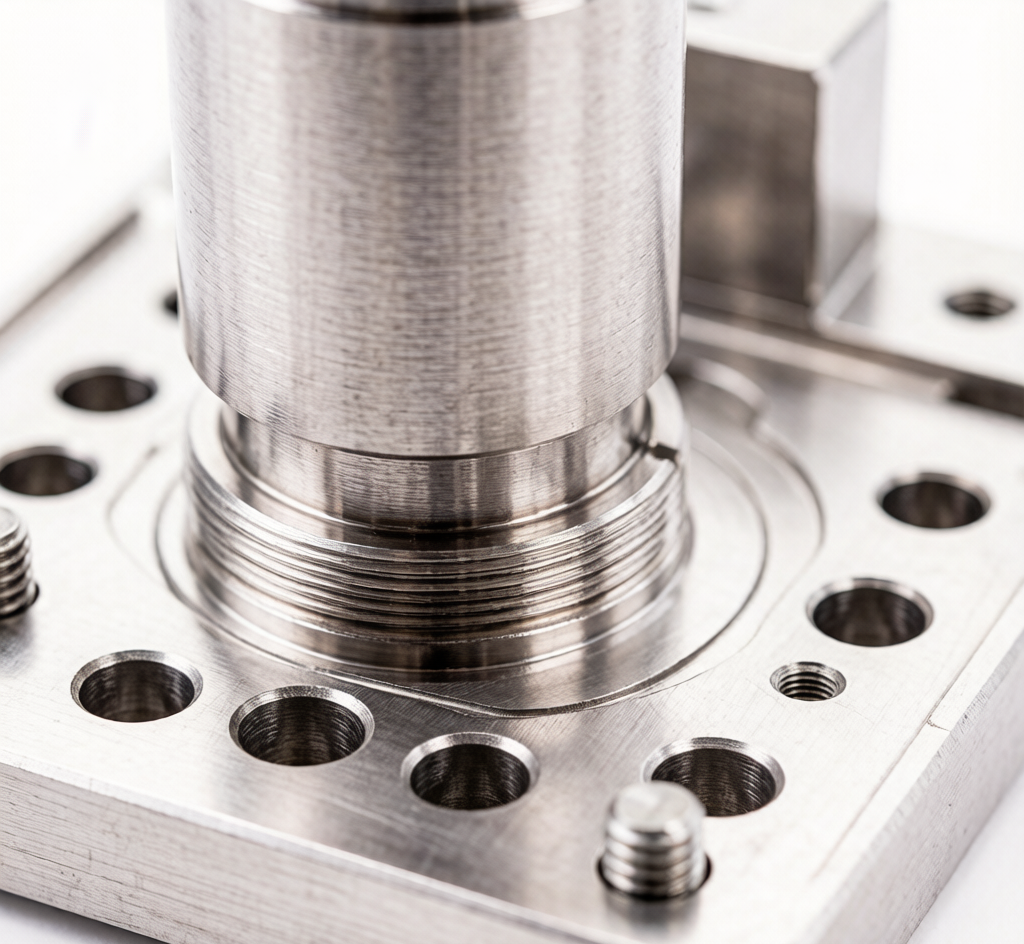
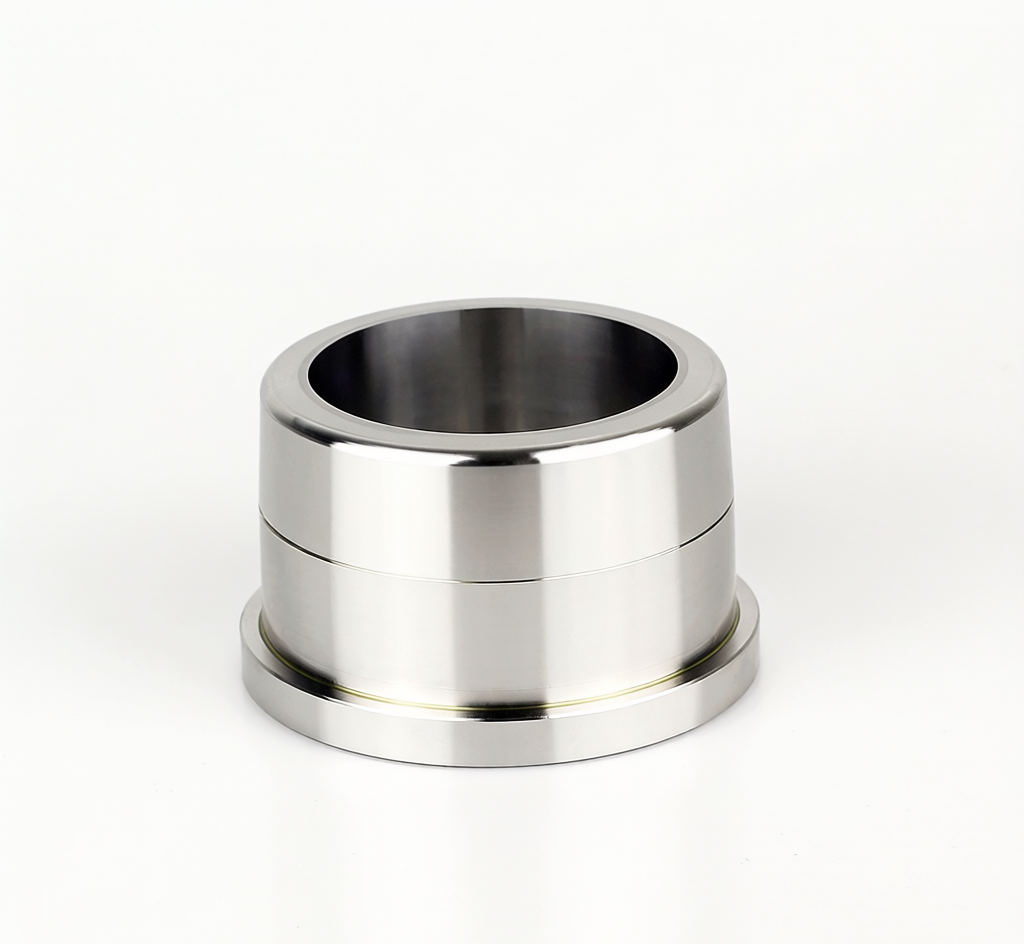
The component shown here is manufactured by SHENGQI PRECISION from hardened tool steel (SKD61 or equivalent), featuring a stepped outer profile with an integral flange for positive location in the stripper plate bore, and a mirror-polished inner tapered surface (Ra ≤ 0.2 μm) to minimize friction during high-cycle operation.
Functional Role in Mold Ejection Systems
In a standard stripper-plate ejection system, the mold opens, the stripper plate is held stationary by puller bolts or latch locks while the core side continues to retract, and the molded part — still gripped by the core pins — is stripped off as the relative motion forces it past the stripper plate. The tapered-bore sleeve sits between the ejector pin shank and the stripper plate itself:
- Alignment: The taper pulls the ejector pin into concentric position each time the mold closes, compensating for any thermal expansion or cumulative tolerance stack-up.
- Load distribution: Unlike a straight-bore bushing where contact occurs only at the entrance edge, the tapered bore shares load along its full engaged length, reducing contact stress by 40–60% depending on taper angle.
- Wear resistance: The large-area sliding contact reduces local pressure, extending service life significantly compared to plain bushings.
- Ease of maintenance: A worn sleeve can be replaced without re-machining the entire stripper plate — simply press out the old one and install a new pre-ground unit.
Key Design Parameters
| Parameter | Typical Range | Critical Tolerance |
|---|---|---|
| Taper angle (included) | 1° – 3° | ±0.1° |
| Bore diameter (small end) | Ø8 – Ø80 mm | +0.005 / +0.010 mm (interference fit to pin) |
| Outer diameter (flange) | Bore + 10 – 30 mm | -0.01 / -0.02 mm (press fit to plate) |
| Overall height | 15 – 60 mm | ±0.05 mm |
| Inner surface Ra | ≤ 0.2 μm | Measured full-length |
| Concentricity (ID to OD) | — | ≤ 0.01 mm TIR |
| Material hardness | HRC 48–52 (SKD61) | ±2 HRC uniformity |
Taper Angle Selection Guidelines
The choice of taper angle involves a trade-off between centering force and frictional drag:
- 1°–1.5° (shallow taper): Best for thin-wall packaging molds with short ejection strokes. Low friction but requires tighter manufacturing tolerance on angle accuracy.
- 2°–2.5° (standard taper): The most common choice for general-purpose cap molds, cosmetic container molds, and medical device molds. Good balance of self-centering action and smooth release.
- 3° (steep taper): Used when heavy ejection loads are expected (deep-draw parts, undercut features). Strong centering force but higher axial drag during stripping.
Material Selection and Heat Treatment
SHENGQI manufactures tapered-bore stripper sleeves from three primary material grades, selected based on expected production volume and molding material:
- SKD61 (AISI H13) — Standard grade: Vacuum heat-treated to HRC 48–52 with double tempering. Excellent through-hardness, good toughness, and proven performance up to 2–3 million cycles in unfilled PP/PE applications. The default choice for 80% of cap and packaging mold applications.
- SKH-51 (AISI M2) — High-wear grade: Used when molding glass-filled nylon, PBT with glass fiber, or other abrasive engineering plastics. Hardened to HRC 58–62. The higher wear resistance comes at the cost of reduced toughness; not recommended for molds with significant impact loading.
- SUJ2 / GCr15 — High-precision grade: Through-hardened bearing steel for ultra-high-cavity molds (96+ cavities) where dimensional stability over long production runs is paramount. Surface finish achievable to Ra ≤ 0.1 μm after precision grinding.
Manufacturing Process at SHENGQI
Producing a tapered-bore stripper sleeve that meets the tolerances above requires a carefully controlled process sequence:
- Raw material preparation: Forged bar stock is turned to rough dimensions with 0.3–0.5 mm grinding allowance on all critical surfaces.
- Heat treatment: Vacuum oil quenching followed by double tempering (SKD61) or cryogenic treatment (SUJ2) to stabilize dimensions and relieve internal stress.
- Cylindrical grinding (OD): The outer diameter and flange face are ground to final size with a concentricity fixture ensuring ID-to-OD runout ≤ 0.01 mm.
- Taper grinding (ID): The inner tapered bore is ground on a precision internal grinder equipped with a swiveling workhead set to the specified taper angle. Angle verification is performed using a sine-bar setup or CMM profile measurement before each batch.
- Surface finishing: The tapered bore receives mirror polishing (buffing or abrasive flow machining) to achieve Ra ≤ 0.2 μm. This step is critical — any circumferential scratch mark will become a wear initiation point under cyclic ejection loading.
- Final inspection: 100% inspection of taper angle (CMM), bore diameter (air gauge), concentricity (TIR indicator), surface finish (profilometer), and hardness (Rockwell tester).
Quality Control and Inspection Protocol
Every tapered-bore stripper sleeve leaving SHENGQI’s facility undergoes the following inspection routine, documented on a per-part traceability card:
- Dimensional: Bore diameter at minimum 3 axial positions; OD at flange and body; overall height; flange thickness.
- Geometric: Concentricity (ID to OD) measured on TIR stand; cylindricity of outer body; perpendicularity of flange face to bore axis.
- Surface: Inner bore Ra measured with portable stylus profilometer; visual inspection under 10× magnification for grinding marks or inclusions.
- Material: Hardness test at 3 points (flange, body, bore edge); material certificate retained for traceability.
Common Failure Modes and Maintenance Indicators
Understanding how tapered-bore sleeves fail helps mold maintenance teams schedule replacement proactively:
- Taper wear (bell-mouthing): The most common failure mode. Repeated sliding contact gradually enlarges the bore diameter at the entry end, reducing centering force. Visible as a polished band near the top edge. Replace when bore diameter exceeds +0.015 mm over nominal.
- Galling / scoring: Occurs when lubrication is inadequate or the ejector pin surface is rough. Appears as longitudinal scratches on the tapered bore. Root cause is usually pin condition, not sleeve quality.
- Flange fretting: Micro-motion between the sleeve flange and stripper plate face causes fretting corrosion on the flange back face. Prevented by proper press-fit interference (typically 0.01–0.02 mm).
- Edge chipping: Impact from misaligned mold closing or foreign debris. A chipped bore edge will score the ejector pin — replace immediately if detected.
Why Source Tapered-Bore Stripper Sleeves from SHENGQI?
With over 20 years focused exclusively on precision mould components, SHENGQI PRECISION brings specific advantages to tapered-bore sleeve production:
- Taper grinding expertise: Dedicated internal taper grinders with sub-arc-minute angle repeatability — essential for consistent centering performance across multi-cavity molds where all sleeves must match within ±0.05°.
- Material traceability: Every batch ships with mill certificates and in-house heat treatment records. Full ISO 9001 quality management system coverage.
- Fast turnaround: Standard sleeves ship within 7–10 working days; emergency replacements in 3–5 days from stocked semi-finished blanks.
- Application support: SHENGQI’s engineering team reviews your mold layout and recommends optimal taper angle, material grade, and fit class based on cavity count, cycle time, and resin type — at no additional charge.
For inquiries about tapered-bore stripper sleeves or custom ejection-system components, contact SHENGQI PRECISION at jasonwong@shengqi.com or visit dgshengqi.com.