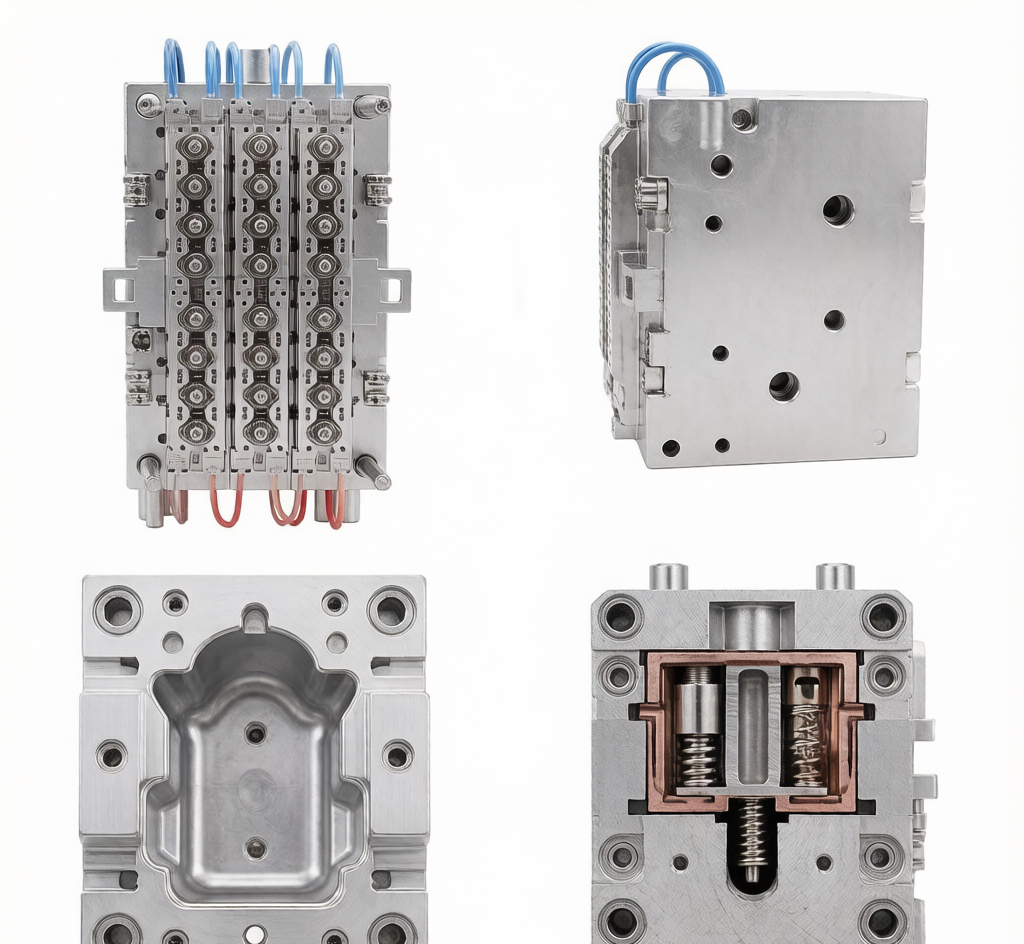
A multi-angle view is the fastest way to evaluate a precision outer cap mold before it reaches the production floor. The image above shows four faces of the same shampoo/lotion flip-top outer cap mold: the cavity side with its multi-cavity layout and cooling hoses, the solid rear mounting plate, a close-up of the cap-shaped impression, and an internal cross-section revealing the ejection and unscrewing mechanism.
What the four views reveal
Each angle answers a different engineering question:
- Top-left: the cavity face with multiple impressions arranged in neat rows, plus blue and red cooling hoses feeding each cavity block.
- Top-right: the back clamping plate with locating holes and bolt patterns for quick machine mounting.
- Bottom-left: a single cap cavity detail, showing the contoured outer-cap shape, parting surface and gate location.
- Bottom-right: an internal section with compression springs, guide pillars and bronze-wear plates, evidence of a balanced ejection system.
Cavity layout and why it matters
The cavity count and pitch determine cycle time, clamp force and part consistency. For cosmetic packaging caps, molds typically run 8 to 64 cavities. A symmetrical layout with uniform runner length helps keep fill pressure and cooling time identical across all impressions, reducing flash and dimensional drift.
Cooling circuit integration
Visible hoses mean the mold uses a dedicated cooling loop for each cavity row. Uniform coolant temperature is critical for thin-wall cap molding because even a 3 °C difference can create sink marks or warpage. Spiral or straight-through circuits are machined into the cavity inserts and sealed with O-rings to prevent leakage under injection pressure.
Ejection and unscrewing mechanism
The cross-section shows spring-return ejector pins and helical components that support unscrewing or stripper action. For threaded or hinged caps, this prevents forced ejection that would distort the parting line or tear the hinge. The bronze guide bushings reduce friction and extend maintenance intervals.
Steel selection and machining
Outer cap molds for high-volume cosmetics packaging usually use P20/718H for the core and cavity, with H13/SKD61 for hotspots around the gate. SHENGQI machines these components on Makino/Jingdiao CNCs and Sodick EDMs, holding tolerances within ±0.005 mm, then polishes critical surfaces to avoid visible parting lines on glossy packaging.
Tolerance and inspection
Key checks include cavity-to-cavity pitch, parting-line flatness, cooling-channel flow rate and ejector-pin alignment. SHENGQI verifies these on Zeiss CMMs and Hexagon vision systems before shipment.
About SHENGQI
Dongguan Shengqi Precision Mould Components Co., Ltd. (SHENGQI PRECISION) has specialized in custom non-standard precision mould components for 21+ years. With two production bases in Dongguan and Huangshi (40,000 m² total), 330+ machining centers and ISO 9001:2015, ISO 13485 and ISO 14001 certifications, SHENGQI delivers a one-stop solution from DFM and mold-flow analysis to final inspection. For outer cap molds, threaded cores and cosmetic packaging inserts, contact Jason Wong at +86 13652919880 or jasonwong@shengqi.com, or visit www.dgshengqi.com.