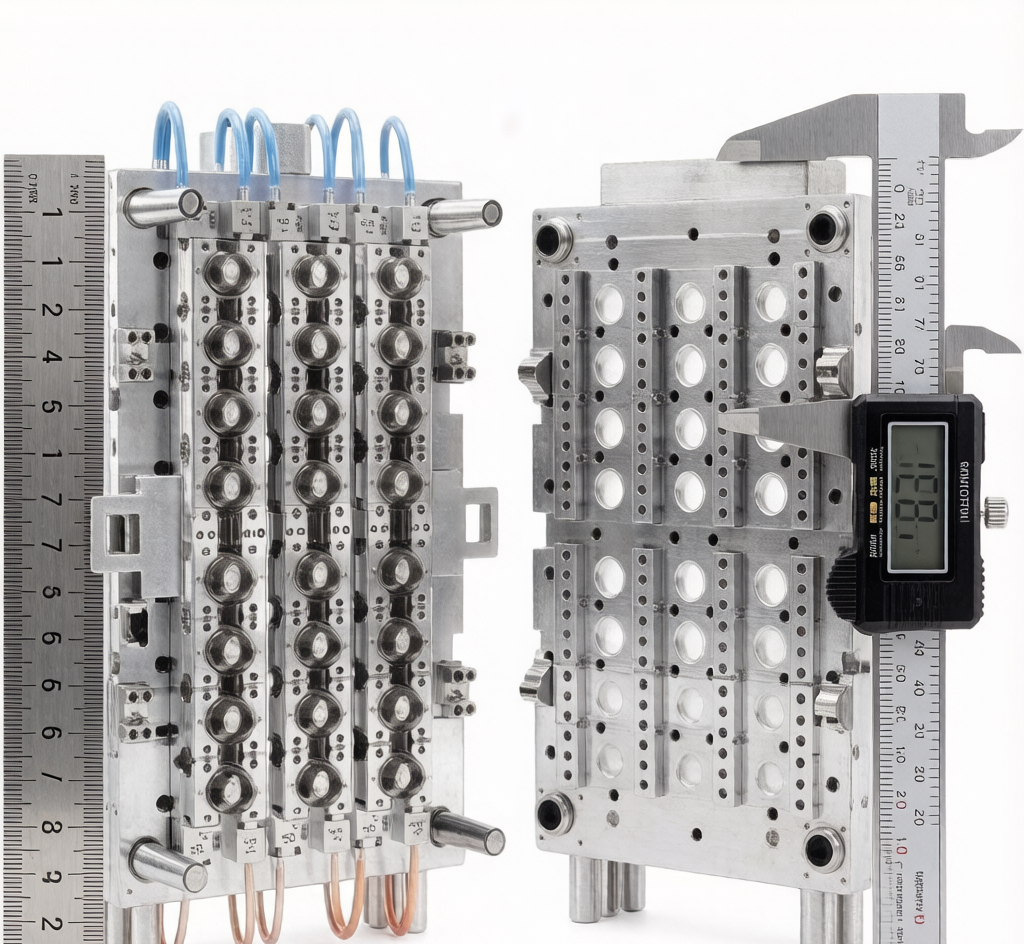
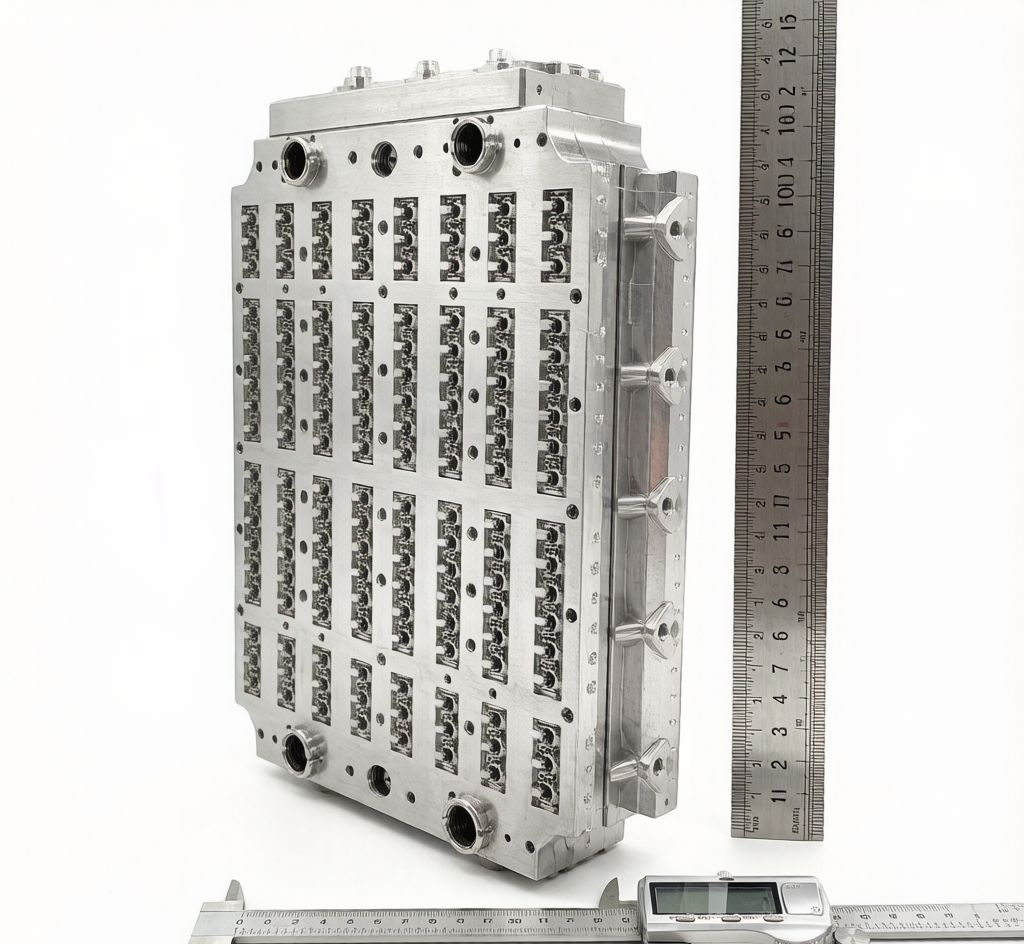
When an international buyer reviews a PP preform mould for IV-bag hanger integration, the first questions after cycle time and cavity count are usually about the physical envelope: how big is the tool, how is it laid out on the platen, and what tolerance budget should be reserved for medical-grade packaging. The dimension reference view below, anchored by a calibrated steel rule and a digital caliper, answers all three at a glance.
1. Reading the Mould Footprint
The reference shot shows the mould plate at roughly 500–600 mm tall by 450–550 mm wide, with a total stack depth (including the support pillars and water-line fittings) of about 400 mm. For procurement, those three numbers map directly to the tie-bar clearance and the maximum mould-height stroke of the target injection moulding machine.
- Platen footprint: compatible with a mid-tonnage horizontal IMM in the 250–400 t class.
- Stack height: must be verified against the machine’s mould-height stroke window before tryout.
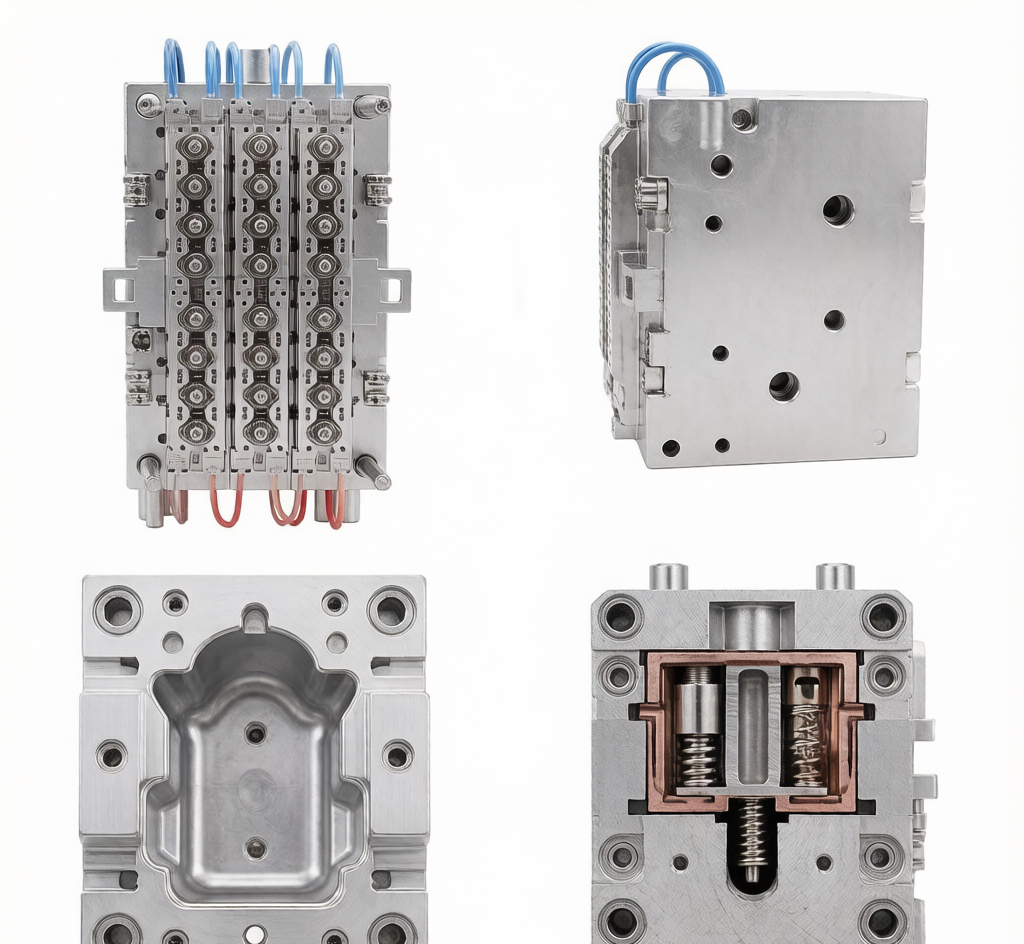
- Support pillars: visible on the rear face, distributing clamping force evenly across the cavity plate.
2. Cavity Layout: From 8-Cavity Pilot to 48-Cavity Production
The photograph reveals a 48-cavity layout arranged in a 6-row × 8-column grid, the typical production configuration for an IV-bag hanger preform mould that targets several hundred thousand units per day. SHENGQI routinely engineers the same preform family in 24-, 32-, 48- and 72-cavity variants so that the customer can scale capacity in line with filling-line throughput without changing downstream tooling.
The cavity pitch is held to ±0.01 mm across the grid so that the integrated hanger geometry stays concentric with the preform neck finish. Any pitch drift would translate directly into a tilt at the hanger hook — which the filling line detects immediately.
3. Critical Dimensions and Tolerance Budget
For IV-bag hangers, the dimensions that actually drive qualification are on the parts, not on the plates:
- Neck finish (Ø and thread profile): ±0.05 mm to mate with the standard PP closure.
- Hanger web thickness: 1.2 ± 0.10 mm — too thin and the part fails drop tests; too thick and the cycle suffers.
- Preform weight repeatability: CPK ≥ 1.67 across 32 consecutive shots at the gate.
- Parting-line witness: ≤ 0.03 mm flash, eliminated at tryout rather than in serial production.
The mould base is roughed out on a MAKINO / DMG horizontal machining center, deep-hole-drilled for the water-line network, finished with SODICK wire-cut EDM for the cavities and OKAMOTO / KENT surface grinding for the parting surfaces. Every plate is then CMM-checked on a ZEISS or HEXAGON coordinate measuring machine before assembly, so the numbers visible on the photograph correspond to the as-built geometry, not the as-designed model.
4. Material and Heat Treatment Strategy
Cavity and core inserts use S136 stainless steel (DIN 1.2083) for medical-grade cleanliness — the steel polishes to mirror Ra ≤ 0.05 µm, resists corrosion from cleaning agents and autoclave steam, and is vacuum-hardened to HRC 50–54. The cavity retainer plate and support plate use P20 pre-hardened steel (HRC 30–34) for impact absorption, and the backing plate uses S50C for stiffness. After stress-relief tempering, every critical insert receives vacuum heat treatment to suppress scale and preserve the polished surface.
5. Why a Dimension Reference Shot Speeds Up RFQ
For an overseas mould buyer, the difference between a 48-cavity tool that fits an existing IMM and one that requires a new press is tens of thousands of dollars. A photograph with a steel rule and a caliper — anchored to the mould, not the bench — is enough to confirm platen fit, ejector stroke and cooling layout before drawings are exchanged. SHENGQI’s standard quotation package therefore always includes:
- A calibrated dimension reference photograph (this kind of shot).
- A 2D mould layout with cooling and hot-runner channels marked.
- A cavity-count / cycle-time matrix for the selected configuration.
- A preliminary CMM report for the as-built cavity plate.
6. From Reference Shot to Production Tool
The dimension reference shot is the starting point of a documented handover: it is filed alongside the DFM review, the mold-flow analysis report and the first-article inspection log. Throughout the tool’s life, the same three dimensions (footprint, stack height, cavity pitch) are re-measured at every scheduled maintenance interval so that the mould keeps producing medical-grade preforms within the validated tolerance window.
About SHENGQI Precision
Dongguan Shengqi Precision Mould Components Co., Ltd. (SHENGQI PRECISION) is a specialist manufacturer of custom non-standard precision mould components with 21+ years of experience. Operating from two production bases in Dongguan and Huangshi (40,000 m² total) with 330+ machining centers and a team of 380+ engineers and technicians, SHENGQI delivers a one-stop solution covering DFM, mold-flow analysis, material selection, precision machining, surface treatment and full inspection. The company is certified to ISO 9001:2015, ISO 13485 (medical) and ISO 14001, and supplies international-standard components compatible with MISUMI, DME, HASCO and FIBRO systems.
Contact: Jason Wong · +86 13652919880 · jasonwong@shengqi.com · www.dgshengqi.com